Mobility vs Stretching: What Actually Matters (and What Doesn't)
Mobility vs stretching: mobility is strength at end range. Here's when to stretch, when to load, and why your starting point changes the answer.
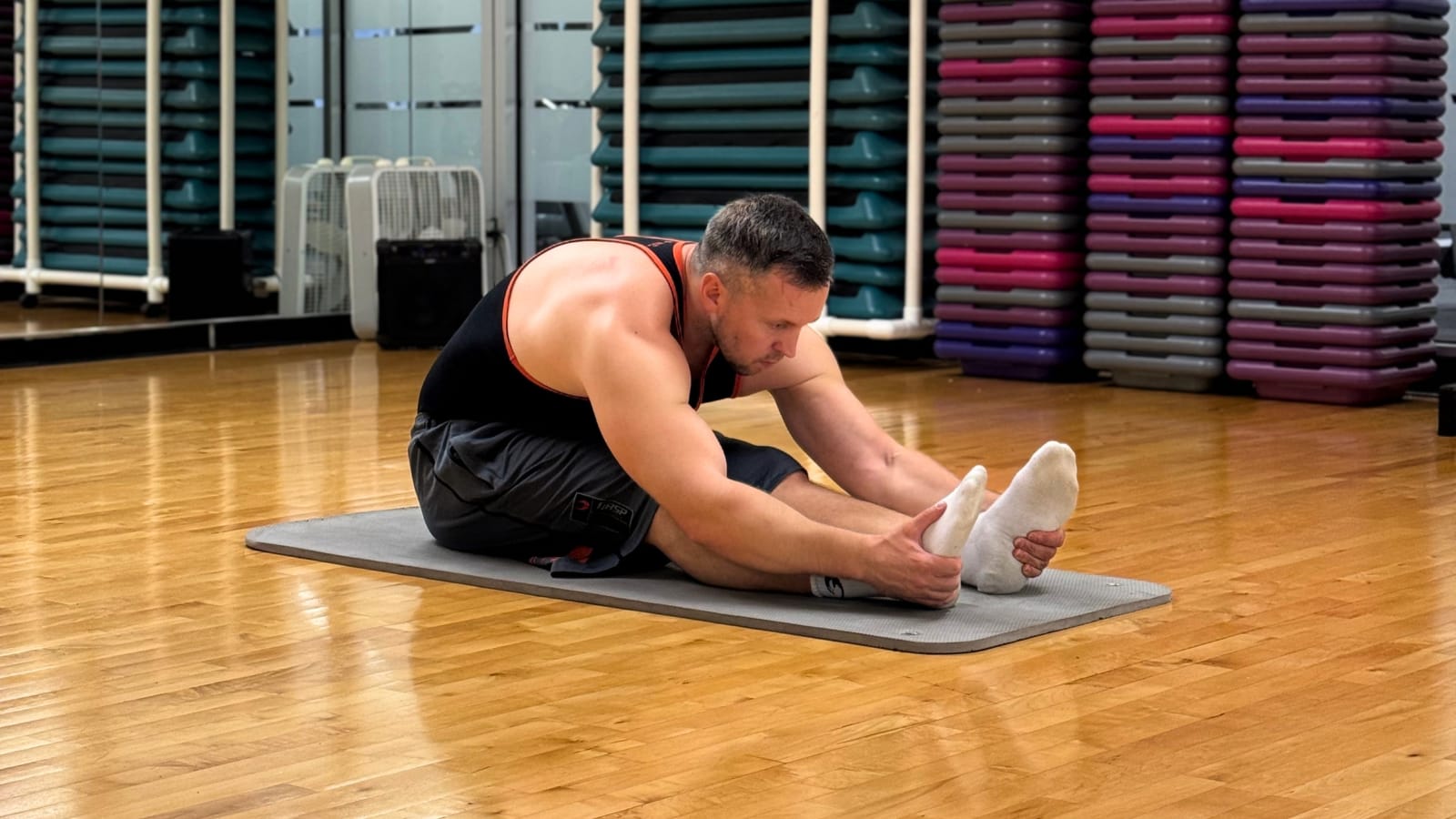
Your hamstrings feel tight. You stretch them. They feel better for about ten minutes, and the next morning they're tight again.
In 16 years of coaching, that's the most common loop I watch people run. It's also why the mobility vs stretching question keeps getting answered badly. Most advice solves for the sensation instead of the cause. Tight is a feeling. It isn't always a length problem.
Mobility vs stretching is a strength question
Flexibility is how far a joint can be moved. Mobility is how far you can move it yourself, with control, and still produce force once you get there.
Mobility is strength at end range.
That definition does all the work. Passive stretching increases how far you can be moved, mostly by changing your tolerance to the position. What it doesn't do is teach you to own the position: hold it, load it, and get out of it under your own power. The range opens, then closes again, because nothing was built.
I've made a version of this argument before, writing about training past 40. Connective tissue adapts slower than muscle. The extension here is that it's also true of range. A range you can be pushed into is not a range you control, and range without control is just more room to fail in.
The mechanism holds up in the research. Strength training through a full range of motion improves range of motion about as much as stretching does, and it builds strength in that new range at the same time. Stretching does the first half only.
What actually lowers injury risk
Strength training has the best injury-prevention evidence of anything you can do in a gym. In the trials, it cut sports injury rates by roughly two thirds. Stretching programs, tested the same way, didn't produce a meaningful reduction.
Two honest caveats. Those trials ran on athletes and military recruits, not on adults training three times a week, so treat two thirds as a direction and not as your personal number. And there's newer, thinner evidence that stretching may help specifically with muscle strains, even though it doesn't move overall injury rates.
The practical read is still clear. If you're stretching mainly to stay healthy, you're spending your time on the weaker intervention.
Should you stretch before or after a workout?
Dynamic before. Static after.
Dynamic work means leg swings, hip circles, bodyweight squats to depth, and light warm-up sets of the lift you're about to do. It raises tissue temperature and rehearses the pattern. You get into range while producing force, which is the entire point.
Long static holds right before a heavy set work against you. Hold a stretch on one muscle for a minute or more and you lose measurable force in it for a while afterward. Keep it under about 30 seconds and the effect is small enough to ignore, especially when dynamic work follows it.
So the rule isn't "never stretch before lifting":
- If a static stretch helps you reach a position (ankles before squats, for example), keep it to 30 seconds or less per position
- Put the dynamic work and warm-up sets after that stretch, not before
- Save the long holds for after training or a separate session
And be honest about what the after-training stretch is for. It's a low-cost window to work on range. It isn't a recovery tool. The evidence that stretching reduces soreness is weak.
Stiff or hypermobile? The answer flips
This is where most advice stops, and it's the part that decides everything. Two people ask the same question and need opposite prescriptions.
If you're stiff. You can't reach a full squat, your shoulders don't get overhead without your ribs flaring, positions feel blocked. You do need more range. But earn it instead of stretching into it. Get into the position, load it lightly, and hold. Deep goblet squat holds. Slow full-range push-ups. Dead hangs. Split squats where the back knee actually gets down. Bodyweight training fits well here, because the progressions are built around control rather than load. Stretch afterward if you want, but the loaded version is what sticks.
One thing to rule out first: if you've recently come back from a long break, "tight" is often just untrained. Deconditioned tissue reports as stiff, and the fix there is progressive loading, not more stretching.
If you're already loose. You reach the floor easily, your elbows and knees hyperextend, people have called you flexible your whole life. More stretching is the last thing you need. You have the range. What you don't have is control of it, and that gap is where you're getting hurt. Your work is strength through the range you already own: slow, full-range, controlled, with real load.
If you've been diagnosed with a hypermobility condition, talk to your doctor or physical therapist before changing your training. That's their call to make, not a trainer's.
What to do this week
- Pick the two positions that limit you most. For most people it's a deep squat and getting overhead.
- Spend five minutes before training on dynamic work in those positions, then your warm-up sets.
- Add one loaded end-range hold per session. Twenty to thirty seconds, light, controlled. The exercise library covers the technique.
- Move your long static stretching to after training or its own day.
Run that for a month and you'll learn more about whether you're stiff or just untrained than any article can tell you.
If you'd rather not guess at it, that's what an assessment is for. Send a message and we'll start with a call.
Get new posts by email
Training, nutrition, and staying consistent — straight to your inbox. No spam, unsubscribe anytime.